Tired of Paying $200/Month for Load Boards? Here Are Your Options.
Add it up: the subscription fees, the 40-80 hours a month on the phone, the calls where the broker already gave the load to someone else 10 minutes before you rang. That's the real cost. Most owner-operators have never actually done that math.
Real Alternatives
Six Ways to Find Loads Without a Subscription
Load boards are fine for some operators. But for most owner-operators using them full-time, there are better options - with the honest tradeoffs of each.
Dispatch Services
You pay as a percentage of what you earn - not a flat monthly fee. At 6% on $15,000 gross, that's $900/month. Compare: $200 DAT subscription plus 60+ hours of calls that earned you below-market rates anyway.
Direct Shipper Relationships
The best rates in trucking come from shippers who book you directly, with no broker taking a cut. It takes 3-6 months to build the relationship - but once you have it, those lanes are yours.
Digital Freight Platforms
Amazon Relay, Uber Freight - upfront pricing, no negotiation, consistent volume. Rates are lower than what a dispatched carrier gets, but the reliability is real. Works best as a base-load floor, not your whole operation.
Broker Direct Cold Outreach
Cold-calling brokers without a load board posting works if your carrier packet is tight and you have a track record. Takes persistence and a lot of rejection early. But the relationships you build this way produce the best long-term rates.
Industry Networks and Driver Referrals
Trucking groups, associations, and driver networks pass loads around. Volume is low, but the freight tends to be from shippers who already trust the person who referred you - which means less negotiation and fewer surprises.
Factoring Company Networks
Some freight factoring companies include a load board or broker network access as part of their package. If you're already factoring, ask your factor what they have - it might already be paid for.
The Full Economics
Beyond Load Boards: The Economics of Direct Freight
Most drivers calculate their load board costas the subscription line item. DAT runs $60–$200/month depending on your tier. Truckstop is comparable. But that number misses the actual cost by a wide margin. If you're spending 2–4 hours a day searching boards, making calls, following up, and negotiating, that's 40–80 hours a month. At $35/hour opportunity value - roughly what you could be earning on a load instead of sitting on hold - the time cost alone is $1,400–$2,800 per month. The subscription fee is the smallest part of the bill. The real question is: what are you actually netting from those 40-80 hours? For most operators who feel like they can't find loads consistently, the honest answer is $800-$1,500/month less than dispatched drivers running the same lanes.
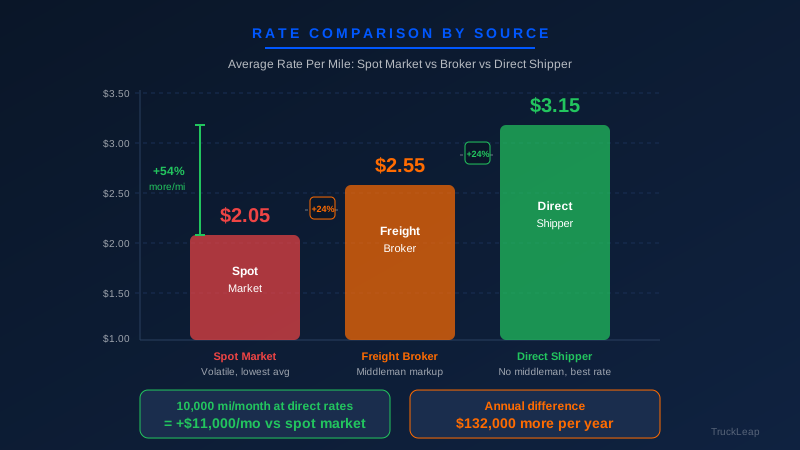
Direct shipper relationships are the highest-value thing in trucking - and they take the most time to build. A shipper who books you directly cuts out the broker entirely, which means rates 15–25% above spot with no middleman. Getting there requires 3–6 months of consistent delivery performance and outreach, but the payoff compounds. Carriers who build 3–4 direct shipper relationships over a year often stop needing load boards entirely. The problem is that while you're building those relationships, you still need freight - which is exactly where dispatch fills the gap.
Amazon Relay sits in its own category. The rates are capped - typically $1.80–$2.20 per mile for dry van - but the volume is reliable and the process is frictionless. No negotiation, no uncertainty, no broker pressure. The way experienced operators use Relay is as a floor: guarantee 3–4 days per week with Relay loads, then use the remaining days for spot or broker freight at higher rates. Using Relay as your whole strategy puts a ceiling on what you can earn. Using it as a baseline while stacking better loads on top is a different outcome entirely.
Dedicated lane contracts are where the real rate advantage lives. Shippers who need consistent capacity - 3–5 loads per week on the same lane - offer $0.25–$0.40/mile above spot in exchange for predictability. On a 500-mile lane running four loads a week, that's $500–$800 more per week than the equivalent spot rate. Most owner-operators never get there because those relationships require months of track record and someone to maintain the shipper contact between loads. That's what dispatch does.
- Real load board cost: subscription plus 40–80 hours/month of your time - not just the $200 line item
- Direct shipper relationships take 3–6 months to build but pay 15–25% above spot with no broker margin
- Use Amazon Relay as a floor for volume stability - not as your primary rate source
- Dedicated lane contracts pay $0.25–$0.40/mile above spot - but require months of consistent delivery to earn
- Dispatched drivers average 40% fewer hours on boards - that time goes back to driving, rest, and compliance
Deep Dive
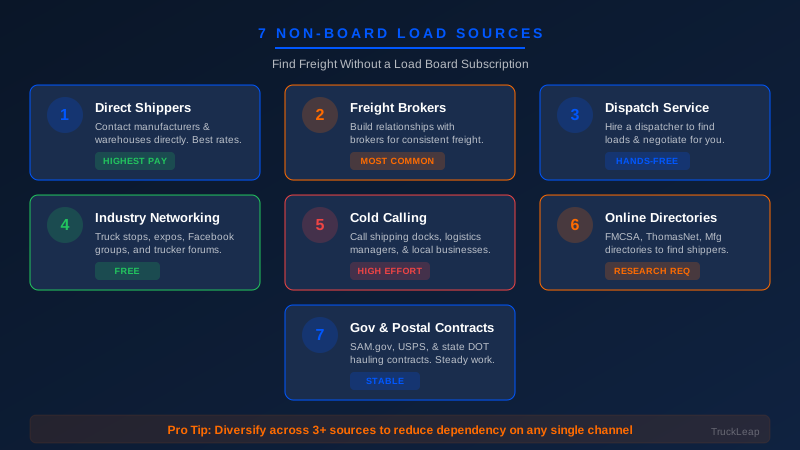
Seven Non-Board Methods to Find Freight
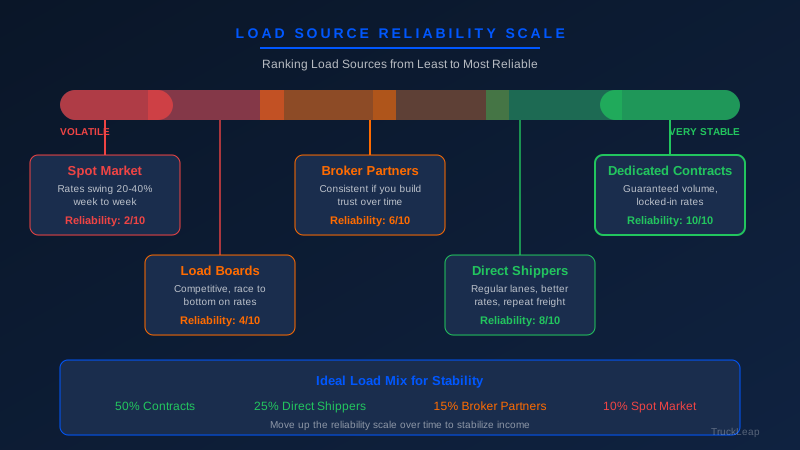
Load boards made sense in 2010. Today, they're crowded marketplaces where 15 trucks compete for every posted load. The owner-operators who consistently run at $2.50+/mile aren't out-bidding you on DAT - they've built freight pipelines that bypass the spot market entirely.
Why Load Boards Are Getting Harder
- Carrier oversupply: the 2021–2022 freight boom attracted tens of thousands of new authorities. Supply outpaced demand and has only partially corrected.
- Broker consolidation: large tech-enabled brokers now use algorithms to post loads, match carriers, and squeeze margins automatically.
- Rate transparency: brokers know exactly what other brokers paid on the same lane last week. You're negotiating blind while they have full market data.
- Dead-end lanes: load boards skew toward difficult freight - short notice, awkward pickup windows, or lanes nobody else wanted.
Method 1: Cold-Call Direct Shippers
Direct shippers pay more per mile than brokers because they're not splitting margin with a middleman. A shipper paying $3.00/mile to a broker might pay you $2.60/mile directly - and still feel like they're saving money.
How to find shippers to call: Google Maps industrial search (search "distribution center," "manufacturing," or "warehouse" in your target city), LinkedIn Company Search filtered by industry, walk-by industrial parks near your home base, and local chambers of commerce member directories.
Expect rejection 90% of the time. The 10% who talk to you are worth thousands per year in consistent lanes. Keep a spreadsheet, follow up quarterly, and be professional when they say no - circumstances change.
Method 2: Work Through Freight Agents
Freight agents are independent brokers who work under a larger brokerage license. They're closer to the business than a big corporate board and often have better relationships with shippers in specific niches.
Find freight agents through the Transportation Intermediaries Association (TIA) directory, Facebook groups for trucking, and by asking other owner-operators who they work with. Unlike load boards, good agents are a relationship business - they get better over time.
Method 3: Build an Owner-Operator Network
The most underused freight source is other truckers. When an owner-operator gets a load they can't cover - because they're broken down, out of hours, or double-booked - they need to hand it off fast. If you're in their contact list, you get the call.
Join Facebook groups for your equipment type and region. Attend trucking trade events. Connect with drivers at truck stops. Be the carrier who shows up on time and communicates. Over time, a 10-person network can keep you consistently loaded without a single load board search.
Method 4: Amazon Relay
Amazon Relay is Amazon's direct carrier program. You haul freight in Amazon's network - primarily trailer drops between fulfillment centers - and Amazon pays you directly, fast, with no broker in the middle.
What makes it appealing: Consistent volume (Amazon ships every day of the year), fast payment (often within days), and predictable freight - drop trailers, clear instructions, no negotiation.
The catch:Rigid pickup windows (missing by even 30 minutes can hurt your score), rates are non-negotiable and tend to run $1.80–$2.40/mile, and dock congestion at some facilities is severe. Works best as a volume-filler when you need consistent miles but don't have enough direct shipper volume yet.
Method 5: Dedicated Contract Freight
A dedicated contract means a shipper or carrier assigns you a specific route or account, usually with guaranteed minimum miles per week. You're essentially their truck without being their employee.
Look at large LTL carriers (Estes, Old Dominion, XPO) for regional overflow, regional private fleets (grocery chains, big-box retailers), and direct contact with manufacturers who have consistent outbound freight on fixed schedules. Dedicated freight pays slightly less per mile than spot market peaks but dramatically more than spot market lows.
Method 6: Carrier Partnerships (Leasing Under a Larger Carrier)
Leasing your authority under an established carrier gives you access to their freight network without load board subscriptions. The carrier takes a percentage (usually 15–25%), but they handle dispatch, fuel cards, and sometimes insurance discounts. Different from being a company driver - you still own your truck. The downside: you're dependent on the carrier's freight quality and volume. Calculate your effective rate using the cost-per-mile calculator before signing.
Method 7: Professional Dispatch Services
A good dispatcher does what you'd do on a load board - except full-time, with established broker relationships, and with negotiation skills you can't replicate spending 2 hours between loads searching DAT. The economics: a dispatcher who finds you $0.30/mile better loads on average on 10,000 monthly miles adds $3,000/month to your revenue. Most dispatch fees run 5–7% of gross, which on those same 10,000 miles at $2.50/mile comes to $1,250–$1,750/month.
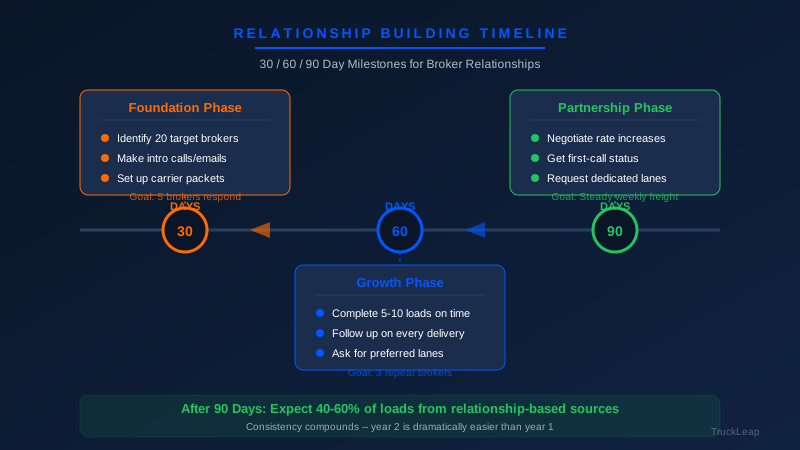
Building Your Freight Pipeline: The Realistic Timeline
| Months 1–3 | Test 2–3 of these methods simultaneously. Identify which fits your equipment and region. |
| Months 4–6 | Double down on what's working. Start building your direct shipper list and agent relationships. |
| Months 7–12 | Load board dependency should be below 30% of your loads. |
| Year 2+ | Most loads come from relationships. Load boards are a backup, not a primary source. |
Deep Dive
Direct Shipper Acquisition: A Step-by-Step Playbook
A freight broker's average margin is 15–25%. That money comes out of your rate. A shipper paying $3.00/mile to a broker might be paying $2.30/mile to you after the cut. That same shipper approached directly might pay you $2.70–$2.80/mile - more for them than broker rates, more for you, and the broker is gone entirely.
Why Most Carriers Don't Have Direct Shippers
The primary reason owner-operators don't pursue direct shippers is friction. The load board is right there. It shows available loads, rates, and pickup times in real time. You can be loaded in hours.
Direct shippers require:
- Research to find them
- Outreach that mostly gets rejected
- A qualification process (carrier packet, insurance verification, DOT lookup)
- Patience: weeks or months before a shipper assigns you freight
- A professional presentation that small carriers without an admin team struggle to produce
This friction is exactly why direct shipper relationships pay so well. Most competitors won't do it. The carriers who do it - systematically, patiently, professionally - build a freight base that's insulated from spot market volatility.
Step 1: Find Shippers Worth Approaching
Not every business with a loading dock is worth your time. The ideal direct shipper target has:
- Consistent outbound freight volume - 2+ loads per week minimum
- Routes that match your equipment and home base
- Freight your equipment can handle
Research methods:
Google Maps industrial search - search "distribution center," "manufacturing," "food processing plant," or "warehouse" in your target city. Switch to satellite view to identify buildings with loading docks.
LinkedIn Company Search - filter by industry, company size, and location. Look for the person with a title like "Logistics Manager," "Traffic Coordinator," "Transportation Manager," or "Supply Chain Manager."
State manufacturing directories - most state economic development offices publish directories of manufacturers. Free, comprehensive, and often sortable by industry.
Step 2: The Cold Call That Actually Works
Cold calling shippers is not about selling - it's about identifying opportunity and planting a seed. Most initial calls don't generate immediate freight. They generate a name in someone's contact list that gets called when their carrier lets them down.
The contact you want: Logistics manager, traffic coordinator, or transportation manager. Don't call the front desk and ask to speak with "someone in shipping." Be specific.
What to listen for: Do they have consistent outbound volume on lanes you run? Are they happy with their current carriers or frustrated? Is there a procurement process, or does the logistics manager make these decisions? When do their contracts renew?
If they say no:"I understand completely. Would it be okay if I called back in 6 months? Carrier situations change." Get their name, note the date, and follow up. Persistence - professional and non-harassing - is what separates carriers who land direct accounts from those who don't.
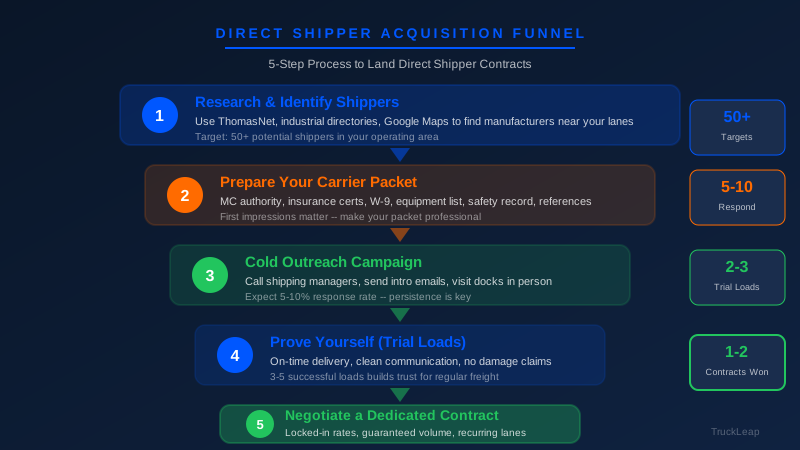
Step 3: The Carrier Qualification Process
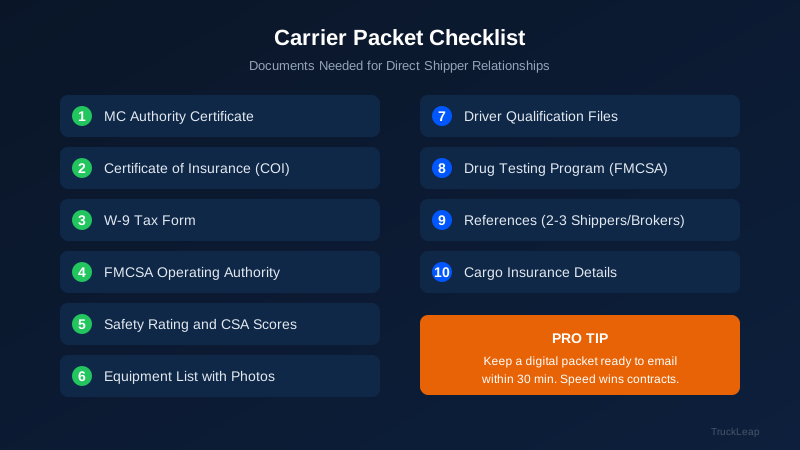
When a shipper is interested, they'll ask you to complete a carrier packet. Expect to provide:
- W-9 form
- Certificate of Insurance (naming the shipper as additional insured on cargo policy)
- MC Number and DOT Number
- Copy of your operating authority
- Signed carrier agreement (their standard terms)
Keep a folder with these documents always current so you can complete a carrier packet within hours of a shipper requesting it.
Reviewing the agreement: Check payment terms (Net 30 standard), liability limits (some agreements try to make carriers liable for product value, not just transportation), fuel surcharge terms, and exclusivity clauses. If terms are unclear, ask. If unacceptable, negotiate.
Step 4: Pricing Direct Contracts
The goal is to earn more than brokered freight while remaining competitive with what the shipper currently pays through brokers. The pricing formula:
- 1Establish your floor rate using the cost-per-mile calculator
- 2Research what brokers are charging for comparable freight (DAT rate analytics)
- 3Price 10–15% below broker all-in rate - you're eliminating their margin and sharing it with the shipper
- 4Structure a fuel surcharge that adjusts with EIA diesel prices
Example:
- Broker charges shipper $3.20/mile all-in
- Broker pays carrier $2.50/mile
- Your direct rate to shipper: $2.80–$2.90/mile
- Shipper saves $0.30–$0.40/mile, you earn $0.30–$0.40/mile more
Both sides win. Verify profitability with the profit calculator before finalizing any contract rate.
Step 5: Delivering on Your Promise
Landing the account is the beginning, not the end. Direct shippers stay direct shippers only as long as you perform better than the brokers they replaced.
- Consistent availability - if you take their regular lane, they need to count on you every week
- Real-time communication - personally communicate pickup confirmations, en-route updates, and delivery confirmations
- Professional invoicing - invoice the same way every time, within 24 hours of delivery
- Problem communication - when something goes wrong, call immediately. Shippers can handle problems; they can't handle discovering one on their own.
Building a Direct Shipper Pipeline Over 12 Months
| Phase | Activity | Expected Result |
|---|---|---|
| Months 1–2 | Build target list (50+ companies), complete carrier packets | 0–1 direct accounts |
| Months 3–4 | Active cold calling, follow-ups, first shipper meetings | 1–3 direct accounts |
| Months 5–6 | Execute first direct loads, ask for referrals | 2–5 direct accounts |
| Months 7–12 | Renewals, rate negotiations, expand volume | 5–10 direct accounts |
By month 12, owner-operators who execute this process consistently typically have 30–50% of their loads coming from direct relationships. The result is measurable in your revenue per mile, which should improve materially compared to pure spot market operation.
Load Board Questions
Frequently Asked Questions
Beyond the Boards
Carriers Who Quit the Load Board Race
Private freight, broker direct, and dedicated lanes — what they ran instead.
“As a non-CDL box truck owner, the market is flooded with junk loads. TruckLeap found me a dedicated route hauling auto parts that pays double what the load boards offer. If you're serious about making money in a box truck, call them.”
Tyson W.
Houston, TX
Box truck · 26ft non-CDL“The box truck market is tough right now, but TruckLeap has access to private boards I couldn't get on my own. They got me hauling high-value electronics instead of cheap furniture. My RPM has never been higher.”
Elena S.
Miami, FL
Box truck · 26ft non-CDL“I was tired of getting lowballed by brokers who knew I was empty in a dead zone. TruckLeap got me a backhaul out of Laredo that actually covered my fuel and then some. They don't just find loads; they strategize my whole week so I'm not sitting on my hands.”
Pavel G.
Philadelphia, PA
Solo · 2022 Kenworth dry vanDone Paying for Loads You Have to Find Yourself? Apply for Dispatch.
Apply in 5 minutes. We find the freight - you drive it. No subscription, no cold calls, no sitting on hold.
Apply Now - Free Setup