Dispatch vs. Load Board - Let's Run the Numbers
DAT has 400,000 carriers. You're not competing with the market - you're competing with 400,000 versions of yourself looking at the same loads. Here's what the number actually looks like when you run it properly.
The Real Comparison
Dispatch vs. Load Board - Category by Category
Most operators have never added up what a load board actually costs them. Here it is, category by category - with the numbers that change the answer.
Monthly Cost
Load board: $200–400/month in subscriptions. Dispatch: ~$900/month at 6% on $15K gross. But dispatch also replaces the subscription AND the 50-65 hours you were spending searching and calling.
Hours Spent Daily
Load board: 2–3 hours a day searching, calling, following up, and negotiating - 50–65 hours a month of work that doesn't pay you directly. Dispatch: zero. You drive, we handle everything else.
Average Rate Per Mile
Self-dispatched dry van industry average: $2.00–2.20/mile. TruckLeap dispatched drivers: $2.40–2.60/mile on comparable lanes. $0.30–0.40/mile gap doesn't sound like much until you multiply it by 10,000 miles.
Broker Network Size
Your personal contacts: probably 20–50 brokers you've called before. TruckLeap: 200+ broker relationships built over years of consistent volume. More relationships means freight before it gets posted - not after.
Deadhead Management
Load board: you find your next load after you deliver. Dispatch: we start working your next load 4–6 hours before you arrive at delivery. The difference shows up in your deadhead percentage every month.
Net Monthly Income
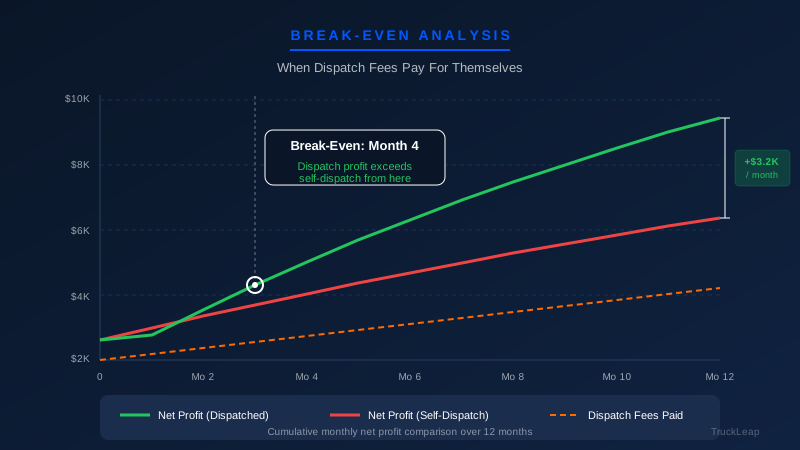
Load board on 10K miles: ~$19,600–21,600 net. TruckLeap dispatch on 10K miles: ~$22,560–24,440 net. Average improvement: $2,500–3,000/month - after the dispatch fee.
Free Tools
Know Your Numbers Before You Decide
The Real Numbers
Dispatch vs. Load Board: A Side-by-Side Cost Analysis
The load board vs. dispatch comparison starts with subscriptions and ends there for most people. That's the wrong place to stop. DAT runs $65–$200/month by tier. Truckstop is $150–$500. Two boards - which is what most serious operators carry - runs $215–$700/month before you make your first call. Then add the time: 2.5–4 hours a day on search, broker calls, paperwork, and follow-up. At $35/hour, that's $1,925–$3,080/month in time cost that shows up as exhaustion and stress rather than a line item on your bank statement. Combined, the real cost of self-dispatching via load board runs $2,100–$3,700/month - before you account for a single dollar of rate differential.
That's where it really breaks open. Dispatched carriers average $0.18–$0.35/mile more than self-dispatched carriers running comparable lanes - that gap comes from rate negotiationand lane-specific data, not luck. At 10,000 miles a month, that's $1,800–$3,500 in revenue that self-dispatched operators leave behind. A 6% dispatch fee on $12,000 gross costs you $720. If the dispatcher gets you $0.18/mile more, you net $1,080 more than you paid in fees. That's before the subscriptions you cancel when you step away from public boards and the 50 hours a month you get back.
There's also a structural reality about what's actually on public load boards. Freight that gets posted publicly has usually been offered to trusted carriers first - one of the same dynamics that freight brokers exploit when they call their primary networks before posting. The loads you see on DAT are what brokers couldn't book any other way - or freight that nobody with a direct relationship wanted. Dispatchers with 200+ broker relationships get calls before postings, which means they're working 25–35% of the brokered freight market that never appears in a public search. If your only access to freight is what gets posted, drivers regularly struggle to find loads every Monday morning.
- Full self-dispatch cost: subscriptions plus 2.5–4 hours/day = $2,100–$3,700/month real cost
- Rate gap: dispatched carriers average $0.18–$0.35/mile more on comparable lanes
- DAT saturation: 400,000+ carriers competing for the same publicly visible freight
- Off-board freight: 25–35% of brokered loads get booked before they're ever posted
- Time back: 50–65 hours a month that goes to driving, rest, or compliance - not broker calls
Deep Dive
What Self-Dispatching Actually Costs You
Every owner-operator faces this decision eventually: spend hours on the phone hunting loads yourself, or hand that work to a dispatcher and pay a percentage off the top. The instinct is to self-dispatch - you keep 100% of the revenue. The math tells a more complicated story.
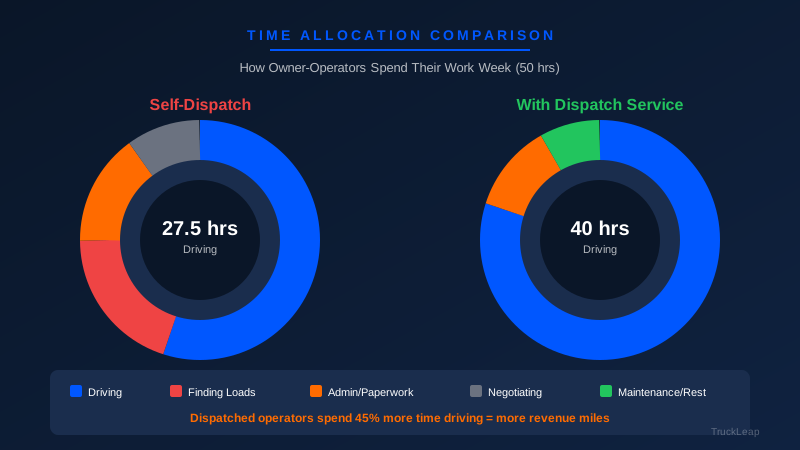
The Hidden Time Cost: 90 Hours a Month
Self-dispatching is not free. The cost is time - and time is your scarcest resource when you're running a truck. A typical owner-operator spends 2–4 hours per day finding, negotiating, and confirming loads when self-dispatching. That includes:
- Checking multiple load boards (DAT, Truckstop, 123Loadboard)
- Calling brokers to negotiate rates
- Completing carrier packets and getting set up with new brokers
- Reviewing and signing rate confirmations
- Following up on invoices and quick pays
At 3 hours per day, that's 90 hours per month. That time comes out of sleep, family, and the driving hours you actually get paid for. Most self-dispatching operators also pull from the open spot market, where rates are lowest. Use the Trucking Profit Calculator to plug in your current rate and see what a $0.20–$0.30/mile improvement does to your annual income.
The Rate Difference: What the Data Shows
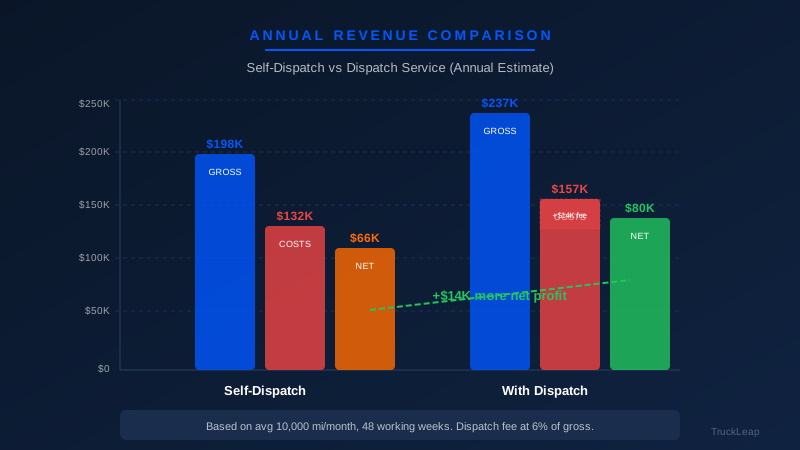
Owner-operators who switch to professional dispatch services report rate improvements of $0.15–$0.40/mile on average. At 10,000 loaded miles per month:
| Scenario | Rate/Mile | Monthly Revenue | Annual Revenue |
|---|---|---|---|
| Self-dispatching (spot market) | $2.25 | $22,500 | $270,000 |
| With dispatch service (6% fee) | $2.55 | $23,970 | $287,640 |
| Net difference | - | +$1,470 | +$17,640 |
The 6% dispatch fee on $2.55/mile is $0.153/mile. The rate improvement is $0.30/mile. Net gain: $0.147/mile - before you count the time savings. Results depend on the dispatcher's broker network, your equipment type, and lanes - but the math illustrates why experienced operators stop thinking of dispatch fees as a cost and start thinking of them as an investment.
The Broker Access Problem (Especially for New Authorities)
New MC numbers and smaller carriers face a specific disadvantage when self-dispatching: brokers have thousands of carriers competing for loads. They prioritize carriers with safety history, strong credit scores, and established relationships. When you call a broker cold, you're at the back of the line. A dispatcher who places 50+ loads per week with that same broker moves you to the front.
This is especially pronounced in the first 1–2 years of operation. Dispatchers who specialize in new authorities (like TruckLeap's new authority dispatch program) have broker contacts specifically willing to work with newer carriers.
The Paperwork Burden Most Operators Underestimate
Each load involves:
- Carrier packet setup (new broker): 20–45 minutes
- Rate confirmation review and signature: 5–10 minutes
- Check call documentation: 5 minutes per load
- Invoice submission and follow-up: 10–20 minutes per load
- Quick-pay application processing: 15 minutes per load
Over 20 loads per month, that's 9–21 hours of administrative work. Every hour spent on paperwork is an hour not spent resting, maintaining your truck, or spending time with your family.
Lane Optimization: The Advantage Nobody Talks About
Self-dispatchers typically take whatever load pays best from their current location. Dispatchers think in sequences - what is the best load OUT of this location that positions you for an even better load AFTERWARD?
Over a month, this lane sequencing can reduce deadhead by 5–10 percentage points. At $1.85/mile in operating costs, eliminating 500 additional deadhead miles per month saves $925/month ($11,100/year) - before the revenue improvement. Check your current deadhead efficiency with the Deadhead Calculator.
When Self-Dispatching Actually Makes Sense
Self-dispatching is the right choice in specific situations:
- You have direct shipper relationships - if shippers call YOU directly, a dispatcher adds no value to those loads
- You run dedicated lanes - consistent work from one or two shippers means no brokerage is needed
- You're in a slow growth market - some regional freight markets are thin enough that a dispatcher can't outperform a well-connected local operator
- You genuinely enjoy the business side - some operators love negotiating rates
Common Questions
Frequently Asked Questions
Beyond DAT & Truckstop
Carriers Who Left the Boards Behind
Private freight networks and dedicated lanes — what's actually out there.
“As a non-CDL box truck owner, the market is flooded with junk loads. TruckLeap found me a dedicated route hauling auto parts that pays double what the load boards offer. If you're serious about making money in a box truck, call them.”
Tyson W.
Houston, TX
Box truck · 26ft non-CDL“The box truck market is tough right now, but TruckLeap has access to private boards I couldn't get on my own. They got me hauling high-value electronics instead of cheap furniture. My RPM has never been higher.”
Elena S.
Miami, FL
Box truck · 26ft non-CDL“I was tired of getting lowballed by brokers who knew I was empty in a dead zone. TruckLeap got me a backhaul out of Laredo that actually covered my fuel and then some. They don't just find loads; they strategize my whole week so I'm not sitting on my hands.”
Pavel G.
Philadelphia, PA
Solo · 2022 Kenworth dry vanThe Math Works. Run It On Your Numbers and Apply.
Apply in 5 minutes. No setup fees. We start working your lanes within 48 hours.
Apply Now - Free Setup