One Simple Fee. No Surprises.
5% of gross load revenue for most owner-operators - and just 4% for fleets. No setup fees, no monthly bills, no contracts. If you don't haul, you don't pay.
Our Pricing
Dispatch Fee Tiers
Your rate depends on fleet size and how long you've had your authority
New Authority
7%
New MC, box trucks & hotshots
For new MC authorities (under 6 months), plus box truck and hotshot operators. These are higher-touch to dispatch - brokers are cautious with new carriers, and box/hotshot freight takes more legwork to source and negotiate. New MCs automatically move to the Standard 5% once you hit 6 months.
Standard
5%
1 truck, 6+ months authority
The rate most owner-operators pay. Covers everything: load sourcing, rate negotiation, all broker calls, deadhead planning, and weekly reports. No contracts.
Fleet
4%
2+ trucks · limited-time rate
Running 2 or more trucks? We've dropped fleet dispatch to a discounted 4% - our lowest rate. A dedicated dispatcher handles your whole fleet, and the volume plus this special offer make it the best value in trucking.
Refer a Carrier, Earn $200
Know an owner-operator who needs loads? Refer them to TruckLeap. When they complete their first month of hauling with us, you get $200 cash - or $200 off your own dispatch fees. Your call. No limit on how many carriers you refer.
Refer a carrier
Send them our way - they apply and mention your name or MC number.
They haul for a month
Once your referral completes one month of successful hauling with us.
You get paid
$200 cash, or $200 knocked off your dispatch fees. You choose.
Payout after your referral's first full month of hauling. Cash or fee credit, your choice.
Full Service
Everything That's Covered
- ✓Daily load sourcing on all major load boards and direct contacts
- ✓Rate negotiation on every single load - we push back on low offers
- ✓All broker calls, check calls, and delivery confirmations
- ✓Deadhead planning - we pre-book your next load before you deliver
- ✓Weekly earnings reports with full rate and mileage breakdown
- ✓Carrier packet setup with major brokers during onboarding
- ✓Dispatcher available when loads need to move - including nights and weekends
- ✓Month-to-month - no long-term contract, cancel with 30 days notice
How We Compare
| TruckLeap | Industry | Self-Dispatch | |
|---|---|---|---|
| Fee | 4–7% | 8–12% | $0 |
| Setup fee | None | Often yes | None |
| Contract | None | Often 1yr | None |
| Load sourcing | ✓ | ✓ | Your time |
| Negotiations | ✓ | ✓ | Your skill |
| Time cost | Minimal | Minimal | 2–4 hrs/day |
Run Your Numbers
Run the Math for Your Truck
Monthly Savings Calculator
See how much you save vs. the industry average dispatch rate
Enter your monthly gross above to see your savings
Deep Dive
What Dispatch Services Actually Charge (and Why)
Dispatcher pricing is one of the least-transparent parts of the trucking industry. You'll see claims ranging from 5% to 15%, flat fees of $200/week to $800/month, and everything in between. Some of those numbers are reasonable. Some are exploitative. Here's the breakdown of what dispatch services actually charge, what each model means for your bottom line, and how to evaluate whether a quote is fair.
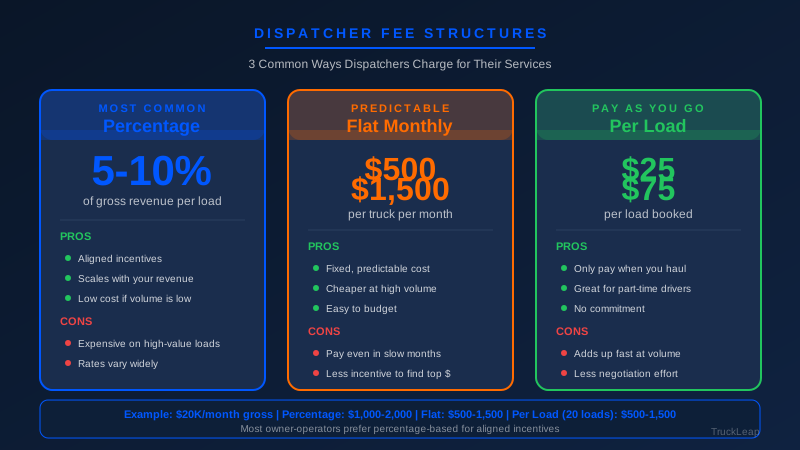
The Three Pricing Models
1. Percentage of Gross Revenue (Most Common)
The dispatcher charges a percentage of the gross revenue on every load they book for you. Industry standard range: 5–7%. At $2.50/mile over 10,000 miles in a month ($25,000 gross):
| Percentage | Dispatch Fee | Your Net Revenue |
|---|---|---|
| 5% | $1,250 | $23,750 |
| 6% | $1,500 | $23,500 |
| 7% | $1,750 | $23,250 |
| 10% | $2,500 | $22,500 |
| 12% | $3,000 | $22,000 |
The percentage model aligns incentives: the dispatcher earns more when they negotiate higher rates. Red flag:Any dispatcher charging 10%+ is out of market unless they're providing extensive additional services (factoring, compliance management, dedicated after-hours support).
2. Flat Monthly Fee
A fixed fee regardless of load count or revenue. Common range: $300–$700/month per truck. Can favor high-revenue operators - a $500 flat fee on $30,000/month is 1.7%, but $500 on $12,000/month is 4.2%. The downside: the dispatcher has no financial incentive to negotiate better rates. They earn the same whether they book you at $2.10/mile or $2.60/mile.
3. Hybrid Model
A base flat fee (often $150–$250/month) plus a reduced percentage (3–4%) per load. Covers the dispatcher's administrative overhead while keeping performance incentives in place. Uncommon, but can be a fair structure for both parties.
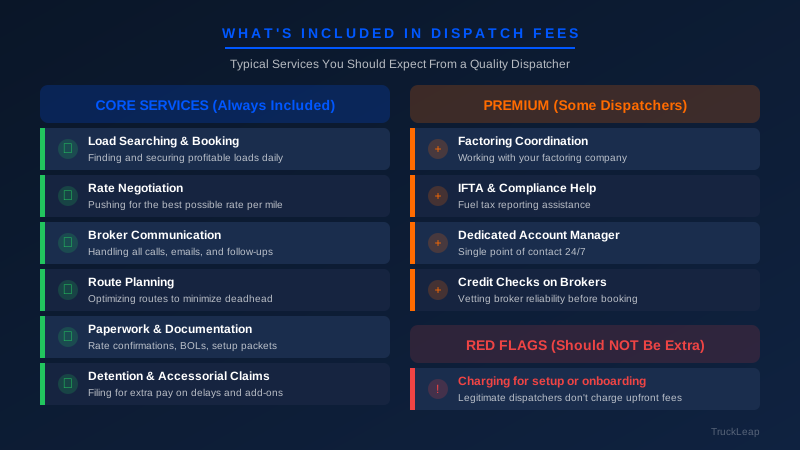
What a Legitimate Dispatch Fee Should Include
A standard dispatch fee at 5–7% should include:
- Load search across all major load boards (DAT, Truckstop, 123Loadboard)
- Rate negotiation with brokers on your behalf
- Rate confirmation review and signature
- Carrier packet setup with new brokers
- Check calls during transit
- Assistance with accessorial charges (detention, layovers, TONU)
- Invoice submission to broker/factoring company
- Market rate guidance on whether a rate is worth taking
Hidden Fees to Watch For
This is where operators get burned. The 6% headline rate can balloon to 10%+ in practice.
Setup / Onboarding Fees
Some dispatchers charge $100–$500 to "set you up in their system" or build your carrier packet library. Legitimate services do not charge setup fees.
Per-Load Administrative Fees
A flat charge ($15–$50) applied to every load on top of the percentage. If you're running 25 loads per month and paying $25/load extra, that's $625/month in hidden costs.
Carrier Packet Fees
Charging per carrier packet they complete on your behalf. Should be included in the percentage.
Quick-Pay Fees
If the dispatcher processes quick pays and takes a cut of the quick-pay fee, this is double-dipping. You're already paying their percentage on the gross rate.
"Premium" Load Board Access Fees
Some dispatchers charge for access to DAT or Truckstop subscriptions that they bill to you at markup. You should be able to verify they are actually paying for these subscriptions.
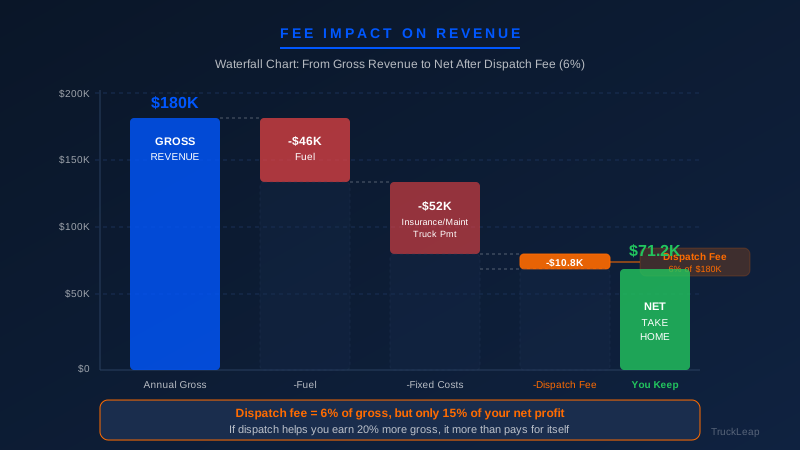
Real Math: What You Actually Net After Dispatch Fees
Scenario: Owner-operator, dry van, 11,000 miles/month
Self-dispatching at $2.25/mile
- Gross: $24,750
- Operating costs at $1.78/mile: $19,580
- Net: $5,170/month
With 6% dispatch service at $2.52/mile
- Gross: $27,720
- Dispatch fee (6%): $1,663
- Operating costs at $1.78/mile: $19,580
- Net: $6,477/month
Monthly gain: $1,307 | Annual gain: $15,684. Even after paying the dispatch fee, the improved rate more than covers the cost. Use the Cost Per Mile Calculator to establish your baseline operating cost, then layer the dispatch fee on top to see your true net per mile.
Industry Standards: What Each Tier Means
- 5–6%: Competitive, fair for owner-operators
- 7%: Acceptable if the service is full-service (check calls, carrier packets, invoice processing)
- 8–9%: High but may be justified for specialized freight (flatbed, heavy haul, hazmat)
- 10%+: Above market; needs strong justification
- 15%: Exploitative; walk away
Contract Terms to Read Carefully
Exclusivity Clauses
Does the dispatcher require you to run ALL your loads through them, or can you still accept direct shipper calls? Most reputable services don't require exclusivity. They earn on what they book.
Termination Terms
Some contracts have 30–90 day notice requirements or early termination fees. Month-to-month contracts are better for operators until you have established trust with the service.
Liability for Bad Loads
If a load the dispatcher books has a problem (incorrect weight, access issues, shipper not ready), who bears the cost? Understand this before signing.
Rate Approval Process
Are you required to accept every load the dispatcher presents? Can you reject a load without penalty? Good dispatchers present options and respect your final decision.
Questions to Ask Before Hiring a Dispatcher
- 1What is your exact fee structure: percentage, flat, or hybrid? Any additional fees?
- 2Which load boards do you search? Do you have direct broker relationships beyond load boards?
- 3What is your average rate per mile for dry van / flatbed / reefer in my lanes?
- 4How do you handle detention, TONU, and accessorial charges?
- 5What are your operating hours? Who covers weekends and nights?
- 6Do you require exclusivity?
- 7What is the contract length and termination policy?
- 8Can I speak to current carrier clients?
A dispatcher who is evasive about any of these questions is one to avoid. A 5% dispatcher who books you at $2.20/mile yields less than a 7% dispatcher who books you at $2.60/mile - don't optimize on the fee percentage in isolation.
Pricing Questions
Common Questions
ROI in Carriers' Words
Carriers Who Saw the Fee Pay for Itself
Three carriers. Three different paths to a positive ROI.
“Best move I made for my business. I'm a single truck owner and the dispatch service fees paid for themselves in the first two weeks just by avoiding the low-paying spot market freight I was picking up on my own.”
Marcus D.
Charlotte, NC
Solo · single truck“I like that TruckLeap is transparent. They send me the original Rate Con from the broker every time so I know exactly what the gross is. No hidden percentages, just honest dispatching for a fair fee.”
Khalid A.
Columbus, OH
2023 Volvo · dry van“I've tried three different dispatch services this year. TruckLeap is the only one that doesn't take 'no' for an answer from brokers. They negotiated an extra $400 on a cross-country run because of the fuel price spike. They pay for themselves.”
Monica D.
Charlotte, NC
Dry van · O/O6% to Haul More, Stress Less
No fees until you haul. No contracts. If the math works for your operation, the application takes 5 minutes.