
Hours of Service (HOS) rules are some of the most important regulations a truck driver must follow. Violate them and you face fines up to $16,000 per violation, out-of-service orders, and damage to your safety rating.
This guide explains every HOS rule in plain English, no legal jargon, just what you need to know to stay compliant and plan your day.
What Are Hours of Service Rules?
Hours of Service (HOS) regulations are federal rules established by the FMCSA (Federal Motor Carrier Safety Administration) under 49 CFR Part 395. They limit how many hours commercial truck drivers can drive and be on duty in a given period.
The rules exist to combat fatigued driving, which is a major cause of fatal truck accidents.
Who must follow HOS rules: All commercial motor vehicle drivers operating vehicles over 10,001 lbs GVWR in interstate commerce, including owner-operators.
The 4 Core HOS Limits for Property-Carrying Drivers
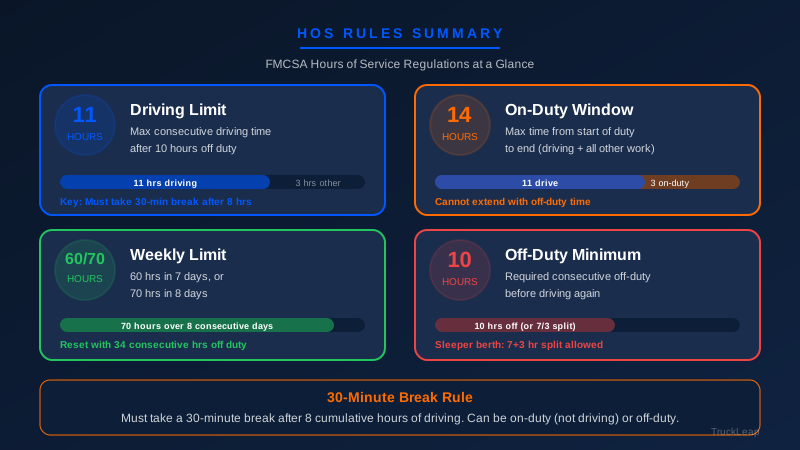
1. The 11-Hour Driving Limit
You may drive a maximum of 11 hours after 10 consecutive hours off duty.
This is the total driving time per day, not elapsed time, but actual time behind the wheel with the engine in gear and the truck moving.
Key point: Once you've driven 11 hours, you cannot drive again until you've had 10 consecutive hours off duty.
2. The 14-Hour On-Duty Window
You may not drive beyond the 14th hour after coming on duty, following 10 consecutive hours off duty.
This is a window, not a clock. Once you go on duty (first activity of the day), you have 14 hours in which you can drive. Off-duty breaks during that window do NOT extend the 14-hour clock.
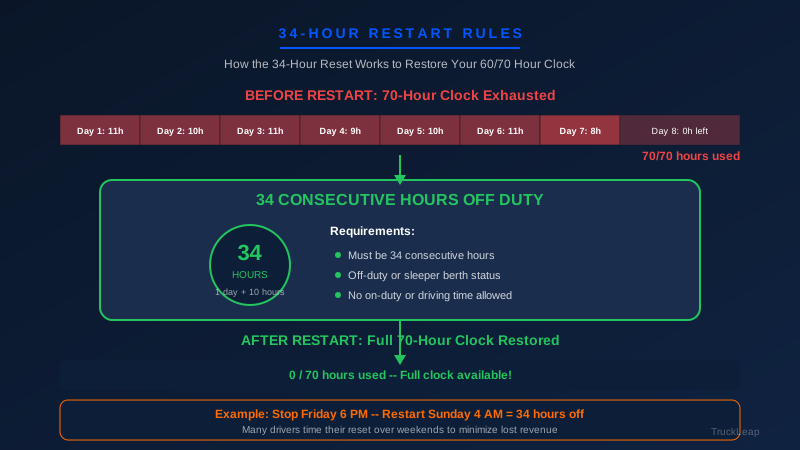
Example: You go on duty at 6:00 AM. Regardless of how many breaks you take, you cannot drive after 8:00 PM, even if you've only driven 7 hours.
This often runs out before the 11-hour driving limit, especially if your day includes pre-trip inspection, loading, waiting at shipper/receiver, or scale house stops.
3. The 30-Minute Break Requirement
You must take a 30-minute break before or when you have driven 8 cumulative hours since your last off-duty or sleeper berth time of at least 30 minutes.
The break must be off-duty or in the sleeper berth. On-duty, not driving does NOT satisfy the break requirement.
Planning tip: Most drivers take their 30-minute break at 6–7 hours of driving to avoid getting caught with nowhere to park at exactly 8 hours.
4. The 60/70-Hour Cycle Limit
You cannot drive after accumulating a certain number of on-duty hours in a rolling period:
- 60 hours in any 7 consecutive days (60/7 cycle)
- 70 hours in any 8 consecutive days (70/8 cycle)
You choose which cycle to use. Most carriers use the 70/8 cycle because it allows more total driving time per week. You can switch cycles with at least 24 hours' notice.
Use our HOS Calculator to track all four limits simultaneously and see how many hours you have remaining.
The 34-Hour Restart
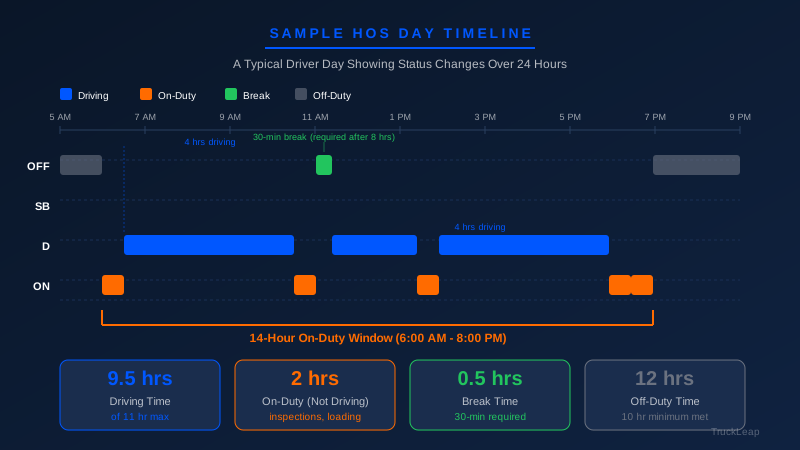
If you run out of cycle hours (or just want to reset), a 34-hour restart allows you to restart your 60- or 70-hour cycle.
How it works: Take 34 or more consecutive hours off duty (or in the sleeper berth). After the restart, your total accumulated on-duty hours reset to zero.
There is no limit on how often you can use the 34-hour restart, but it must be fully consecutive. Any interruption restarts the 34-hour clock.
HOS Violations and Penalties
| Violation | Penalty |
|---|---|
| Driving beyond 11-hour limit | Up to $16,000 |
| Driving beyond 14-hour window | Up to $16,000 |
| Exceeding 60/70-hour cycle | Up to $16,000 |
| No ELD / falsifying records | Up to $16,000 |
| Operating while out-of-service | Up to $25,000 |
At a roadside inspection, a DOT officer can place you out-of-service immediately if you're in violation. That means you park, right there, until the violation clears.
ELD Requirements
Most commercial drivers are required to use an Electronic Logging Device (ELD) to automatically record HOS data. ELDs connect to the truck's engine to capture driving time, sync with your logbook, and are verified at roadside inspections.
Exemptions from ELD: Vehicles older than model year 2000, short-haul operations (within 100 air-miles, returns to home terminal, no more than 14 hours), and a few others.
HOS Planning: Practical Tips
1. Plan around the 14-hour window, not the 11-hour driving limit Many drivers hit the 14-hour window before using 11 driving hours. Know when your window closes before you dispatch.
2. Take your 30-minute break early Don't wait until you're 8 hours into driving with nowhere to stop. Take it at hour 6–7 when you have options.
3. Use the HOS Calculator before dispatch Our HOS Calculator shows your remaining drive time, duty window, break requirement, and cycle hours, all at once, color-coded.
4. Log accurately Every log entry is timestamped by your ELD. Falsification carries the same penalties as violations and can disqualify you from driving.
5. Understand the sleeper berth provision If you have a sleeper berth, you can split your 10-hour off-duty requirement into two periods (at least 7 hours in the sleeper + at least 2 hours off duty). This is the split sleeper berth exception and can help maximize driving time on long hauls.
Quick Reference: HOS Rules Summary
| Rule | Limit |
|---|---|
| Daily driving | 11 hours max |
| On-duty window | 14 hours from first on-duty |
| Before break required | 8 hours of cumulative driving |
| Break duration | 30 minutes minimum |
| Weekly cycle (7-day) | 60 hours max |
| Weekly cycle (8-day) | 70 hours max |
| Cycle reset | 34 consecutive hours off duty |
| Required off duty between shifts | 10 consecutive hours |
Track Your Hours Now
Use our free HOS Calculator. Enter today's hours and see exactly how much drive time, duty window, and cycle time you have left, with color-coded status indicators.
Data sources: FMCSA 49 CFR Part 395, FMCSA Hours of Service guidance documents, Federal Register HOS Final Rule (2020).