
The first year as an owner-operator has a 40–50% failure rate. Not because trucking isn't profitable, but because most new operators underestimate the administrative overhead, overestimate their revenue, and hit their first slow month without enough cash reserves to survive it.
This guide is the survival manual the industry doesn't hand you when you get your authority. Work through it systematically and you'll be in the minority that makes it to year two - and beyond.
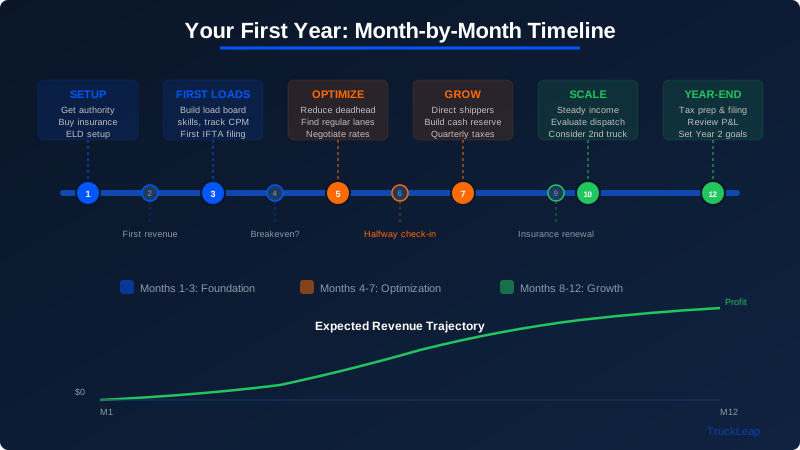
Before You Start: The Foundation Checklist
Before your truck turns a single loaded mile, these items need to be in place:
Business Structure
- Form an LLC or S-Corp (an LLC is sufficient for most single-truck operations)
- Get an EIN (Employer Identification Number) from the IRS (free, takes 10 minutes online)
- Open a dedicated business checking account (never mix personal and business finances)
- Set up bookkeeping software (QuickBooks Self-Employed or a simple spreadsheet to start)
Authority and Operating Credentials
- Register with FMCSA to get your MC Number and DOT Number (apply at safer.fmcsa.dot.gov)
- Wait the mandatory 21-day activation period after receiving your MC Number
- Obtain a UCR (Unified Carrier Registration), required annually
- Set up BOC-3 process agent (required before operating interstate)
- Register for IFTA (International Fuel Tax Agreement) with your base state
Insurance
- Primary liability: minimum $750,000 for most freight, $1M recommended
- Cargo insurance: typically $100,000 minimum, required by most shippers and brokers
- Physical damage: covers your truck (lender will require this if you have a loan)
- Occupational accident or workers' comp (protects you personally if injured)
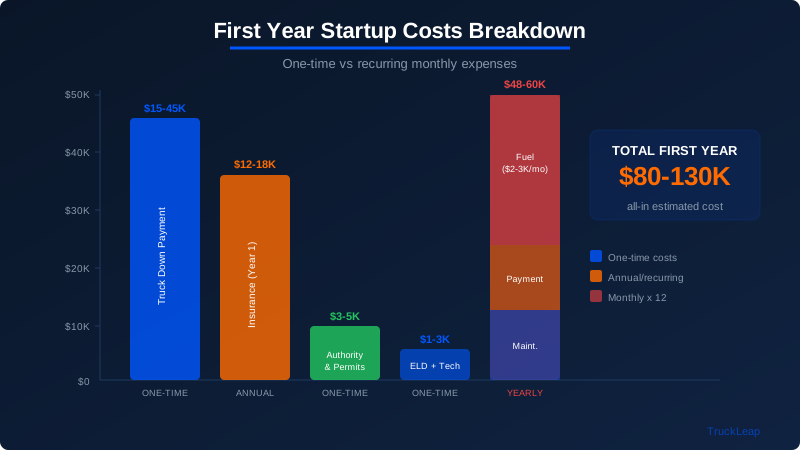
Insurance note: Get quotes from at least three carriers. Insurance is your single largest fixed expense and rates vary enormously. New authority carriers pay more, so expect $12,000–$18,000/year for basic liability + cargo. This improves significantly after 2 years of operating history.
Equipment
- Commercial vehicle titled in your business name (or your personal name if you're sole proprietor)
- Annual DOT inspection completed and sticker displayed
- ELD device installed and connected (required for interstate commerce, most non-exempt carriers)
- IFTA decals ordered from your base state
Months 1–3: Getting Your First Loads and Establishing Cash Flow
The Priority: Generate Revenue Before Anything Else
New owner-operators often spend too much time optimizing and not enough time running. In the first 90 days, your only job is to consistently haul profitable freight and track every dollar.
Getting your first loads:
Option 1 - Lease under an established carrier: Gives you instant access to freight, eliminates the carrier packet process, and provides dispatch support. You'll sacrifice 15–25% of gross revenue. For a new authority carrier with no established broker relationships, this is often the fastest path to revenue.
Option 2 - Work directly with brokers: You'll need to complete carrier packets for each broker (expect 30–60 minute applications that include insurance certificates, authority documents, and W-9). Start by completing carrier packets with the top 15 brokers. This takes a week but unlocks access to their loads.
Option 3 - Use a dispatch service: A dispatcher handles carrier packet submissions, load negotiation, and scheduling. TruckLeap's dispatch service for owner-operators is designed specifically for new authorities who want to run loads immediately without spending weeks on administrative setup. Not sure how dispatch works? Read how our dispatch service works before you decide. View our pricing to see if it makes sense for your operation.
Financial Management in Months 1–3
Cash flow survival rules:
-
Set up factoring from day one. Brokers pay on 30–45 day terms. Factoring companies buy your invoices immediately (for a 2–4% fee) so you don't wait. When you're carrying $3,000–$5,000/week in freight costs, a 45-day payment lag can kill your business before it starts.
-
Track every expense. Fuel, tolls, food, repairs, insurance payments, lease payments, every dollar. You'll need this for quarterly taxes and IFTA filing.
-
Calculate your cost per mile and set a rate floor. Use TruckLeap's cost-per-mile calculator to establish the minimum rate you can accept and still cover your costs. Never haul below this number, regardless of pressure.
-
Build a cash reserve. Target 3 months of fixed expenses in a savings account. Fixed expenses include truck payment, insurance, rent/mortgage, and your phone bill. This is what keeps you running through a slow week or a breakdown.
Key milestone for months 1–3: Haul enough loads to establish your IFTA account activity. IFTA is filed quarterly, and your first return will be due the month after your first operating quarter ends.
Months 3–6: Optimizing Operations and Surviving the First Slow Month
Every new owner-operator hits a wall around month 3–4. The initial excitement fades, the administrative load is heavier than expected, and freight markets may have shifted. This is the phase where most people quit.
IFTA Filing: Your First Quarter Return
If you started operating in Q1 (January–March), your first IFTA return is due April 30. If you started in Q2, it's due July 31.
What you need for your first IFTA return:
- Total miles driven in each state (loaded and empty)
- Total gallons of fuel purchased in each state
- Receipts for all fuel purchases
IFTA calculates the tax owed to each state based on miles driven there versus fuel purchased there. If you bought more fuel in a low-tax state than you burned driving through high-tax states, you may be owed a refund. If you bought less fuel than you burned in high-tax states, you'll owe the difference.
Use TruckLeap's IFTA calculator to run your numbers before filing. It calculates the per-state breakdown, identifies whether you owe or are owed, and generates the figures you need for your state's IFTA form. Don't try to file without running the numbers first. IFTA underpayments carry interest penalties.
Quarterly Estimated Taxes
As a self-employed owner-operator, you pay income tax quarterly rather than annually. The IRS expects payments in April, June, September, and January covering your income from each period.
Rough estimate for tax savings:
- Set aside 25–30% of net profit (revenue minus business expenses) for federal and state taxes
- This is after your business expenses are deducted: fuel, insurance, truck payment interest, repairs, and most operating costs are deductible
Underpaying quarterly estimates results in an IRS penalty at filing time. Overpaying means you get a refund, which is not ideal, but not catastrophic.
Evaluating Your Operation at Month 6
By month 6, you have enough data to evaluate your operation objectively:
- What is your average revenue per mile (loaded)?
- What is your average cost per mile (all miles, loaded and empty)?
- What is your deadhead percentage?
- Are you consistently profitable, or are some months negative?
Run these numbers through TruckLeap's profit calculator to see your true margins. If your cost-per-mile is within $0.20 of your revenue-per-mile, you're running too close to breakeven and need to either raise your rate floor or cut costs.
Months 6–12: Building a Sustainable Business
Move Away from 100% Spot Market
By month 6, you should have broker relationships established and some sense of which lanes and freight types work best for your operation. Now is the time to start building freight relationships that give you more rate consistency.
Options to pursue:
- Dedicated contract freight: Approach shippers or carriers about a contract for specific lanes
- Direct shipper relationships: Start cold-calling shippers in your target regions
- Upgrade your dispatch arrangement: If you're self-dispatching, consider whether the time cost is worth it. Every hour you spend hunting loads is an hour you're not driving.
Annual Renewals and Compliance
At the end of your first year, several things come due:
- UCR renewal: Due in October/November for the following year
- BOC-3 update: Required if your process agent changes
- IFTA decal renewal: Annual renewal through your base state
- Insurance renewal: Negotiate hard. You now have a year of operating history, which should improve your rates
- Annual vehicle inspection: Required before your DOT sticker expires
The Numbers That Predict Second-Year Success
Owner-operators who succeed past year one typically share these characteristics:
| Metric | Healthy Range | Warning Sign |
|---|---|---|
| Revenue per loaded mile | $2.40+ | Below $2.00 |
| Deadhead percentage | Below 15% | Above 25% |
| Cash reserves | 3+ months of fixed costs | Less than 1 month |
| Factoring dependency | Reduced or eliminated | Still 100% dependent |
| Load source diversification | 2+ load sources | 100% spot market only |
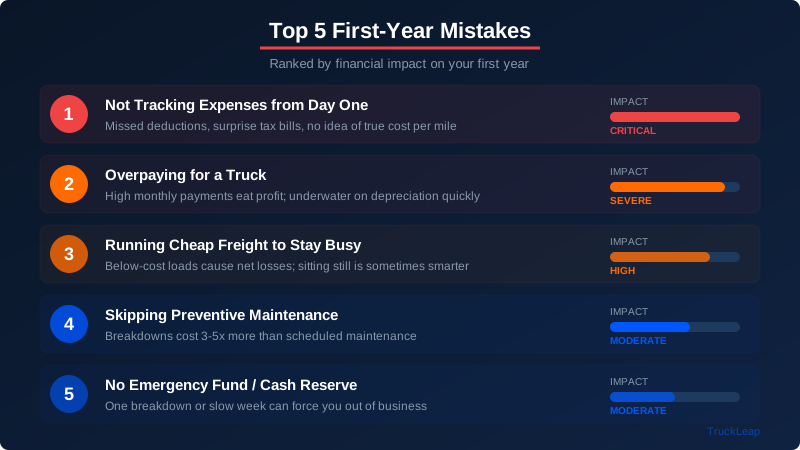
The Mistakes That Kill First-Year Owner-Operators
Mistake 1: Underpricing loads to stay busy A truck that runs at $1.80/mile is worse than a truck that sits for a day and then runs at $2.60/mile. Hauling below-cost loads burns your equipment and your cash without building anything.
Mistake 2: Skipping the cash reserve Breakdowns happen. Freight markets slow. If you have $800 in your business account when your truck needs a $3,500 repair, you're done. Cash reserves aren't optional.
Mistake 3: Ignoring IFTA until it's late IFTA penalties for late filing are real. Set calendar reminders for 30 days before each quarterly deadline and run your numbers with TruckLeap's IFTA calculator before the deadline, not after.
Mistake 4: Not tracking mileage by state You can't file IFTA accurately without state-by-state mileage records. Start tracking this from your first loaded mile. Your ELD likely records this automatically, so confirm it's logging state crossings.
Mistake 5: Hauling every load offered Learn to say no to loads that don't meet your rate floor. Every load you accept sets a precedent with that broker. If you accept $1.70/mile twice, that broker will always offer you $1.70/mile.
Frequently Asked Questions
How much money do I need to start as an owner-operator?
Most financial advisors recommend $15,000–$25,000 in liquid capital beyond your truck purchase and insurance down payment. This covers your first month of operating expenses before freight payments arrive, plus an emergency fund for the inevitable unexpected costs.
Do I need a CDL before getting my authority?
Yes. You must hold a valid CDL (Commercial Driver's License) to operate a commercial motor vehicle over 26,000 lbs. Your CDL must be current before you can legally haul freight.
When do I need to file my first IFTA return?
IFTA is filed quarterly. Your first return is due the last day of the month following your first operating quarter. If you started operating in January, your first IFTA return is due April 30. Use TruckLeap's IFTA calculator to prepare your filing.
Should I use a dispatch service or self-dispatch in my first year?
This depends on your personality and background. If you have strong sales and negotiation skills, self-dispatching can save you 5–7% of gross revenue. If you're uncomfortable negotiating rates or unfamiliar with the broker market, a dispatch service often pays for itself in higher load rates and fewer empty miles. TruckLeap offers a dedicated dispatch program for new authorities with no long-term contracts, built specifically around the challenges of the first 90 days.
How do I handle health insurance as an owner-operator?
This is one of the most significant financial challenges of self-employment. Options include: your spouse's employer plan (if available), ACA marketplace plans (premiums are deductible as a business expense), or trucking industry associations that offer group health rates. Budget $400–$800/month for individual coverage or more for family coverage.