Slow Freight Market? Here's How to Keep Making Money.
Slow markets are brutal on operators with fixed costs and no backup plan. The ones who make it through aren't luckier - they knew which corridors were still moving and had the broker relationships to access them.
Survival Strategies
How to Stay Profitable When Freight Is Slow
There's no magic move in a slow market. But there are responses that work and responses that make things worse. Here's what actually matters.
Know Your Break-Even Before Anything Else
Your expenses don't slow down because freight did. Know your cost per mile exactly. That number tells you which loads to take, which to walk from, and whether you're better off parking than grinding for nothing.
Stop Being Rigid About Geography
Slow markets reward flexibility. Carriers who won't leave their preferred lanes in a downturn sit. Carriers who'll reposition to freight-dense markets - even at a cost - often find 20-30% better weekly gross than those who wait.
Open Up Your Equipment Flexibility
Dry van slow? Reefer loads are still moving. Flatbed quiet? Step-deck and RGN loads don't disappear in a soft market. The more load types you'll consider, the more options your dispatcher has to work with.
Don't Accept First Offers Out of Desperation
Slow markets are when brokers push hardest on rates because they know carriers are feeling the pressure. Our dispatchers don't cave - they use market data to hold the line even when loads are hard to find.
Broker Relationships Are Now Everything
When the public board is empty, it's because freight is getting booked before it gets posted. Brokers are calling the carriers they trust first. That's the only freight available in a real slowdown.
Use the Downtime to Prepare for the Recovery
Every slow market ends. When rates spike, the operators who come out ahead are the ones who spent the slow period building broker relationships, cleaning up their carrier packet, and getting ready - not just waiting.
Free Tools
Know Your Numbers Before Rates Drop Further
Market Intelligence
Surviving and Thriving in a Freight Recession
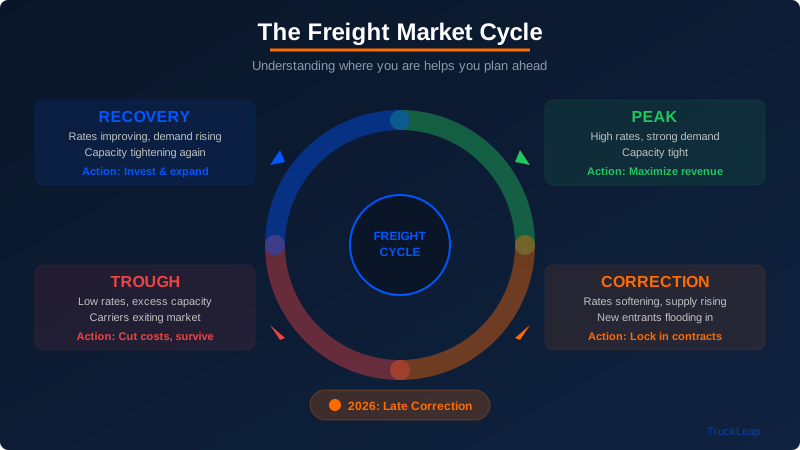
There's a difference between a slow week and a freight recession, and the right response to each is different. A genuine market contraction shows up in two places at the same time: load-to-truck ratios below 2.5 on major equipment types, and spot rates running 15%+ below the 12-month rolling average. When both are present, carriers who simply can't find loads worth taking are not dealing with a temporary lull that'll fix itself in two weeks. You're dealing with a market shift that could last 6–18 months. The 2023-2024 correction stretched past 20 months. Treating a recession like a slow week leads to exactly the kind of decisions - accepting rates that don't cover expenses, burning reserves on marginal loads - that push operators out of the market.
Seasonal patterns are predictable if you know where to look. Q1 - January through March - is historically the softest quarter for dry van every single year. Post-holiday consumer spending drops, retailers flush excess inventory rather than reorder, and spot volume falls with it. That soft stretch typically lasts 6–8 weeks before spring produce season and pre-summer retail replenishment start pulling rates back up. The operators who know this build cash reserves in Q4 and Q2. The ones who don't end up scrambling to cover fixed costs in February.
The tactical moves in a slow market are not complicated, but most people wait too long to make them. Regional runs reduce exposure to volatile national spot rates and cut empty milesat the same time. Reefer and temperature-controlled freight hold rates better in downturns because capacity is naturally tighter and food supply chains don't pause for a soft freight market. Locking in dedicated lane commitments early in a downturn can also stabilize rate-per-mile expectations while spot freight falls. Produce season - April through June, October through November - creates genuine rate spikes that dry van operators can catch if they're willing to run a reefer load during the worst weeks of the year for their normal equipment.
The park-or-run question is a math problem, not a pride question. If your all-in cost is $1.60/mile and the market is paying $1.72 on your lanes, you're earning $0.12/mile before accounting for the maintenance you're putting on the truck. That might not be the right time to be grinding miles. Use our Cost Per Mile Calculator to find your actual break-even, then make the call based on real numbers instead of not wanting to park.
- L:T below 2.5 plus rates 15%+ down from 12-month average means you're in a real contraction, not a soft week
- Build cash in Q4 and Q2 - Q1 and Q3 will slow down every year, without exception
- Move toward regional runs and reefer freight during downturns - they hold up better than OTR dry van
- Cut fixed costs now - not after two more bad months
- Know your break-even before accepting anything below your normal floor rate
Deep Dive
Cash Flow Triage and Cost Discipline in a Downturn
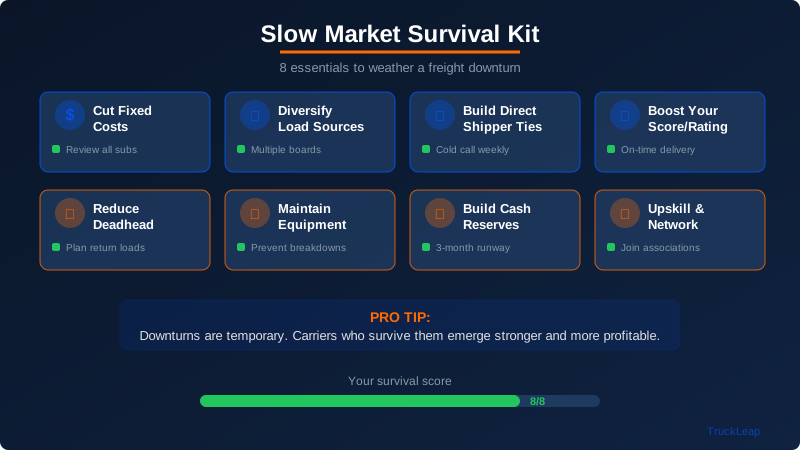
Every owner-operator will face a freight market downturn at some point. The operators who survive these periods - and thrive after them - share specific behaviors. The ones who don't survive make predictable mistakes: chasing bad loads, cutting the wrong costs, running up debt, and giving up before the market turns.
Diagnose Before You React
When freight gets slow, the first instinct is to act immediately - accept lower rates, cut expenses, work more hours. That instinct leads to bad decisions. Before you change anything, understand what you're dealing with.
A slow market means rates are down across the board, loads are harder to find for everyone, and you can verify this by talking to other owner-operators and watching rate indexes. A business problem means rates are fine but you're still struggling - and the cause is usually a cost structure issue, an inefficient route network, or overdependence on a single broker.
Financial Triage in the Right Order
- 1Know your cash runway. Calculate how many months you can operate at your current burn rate with zero new revenue. If less than 2 months, cash preservation becomes your primary objective.
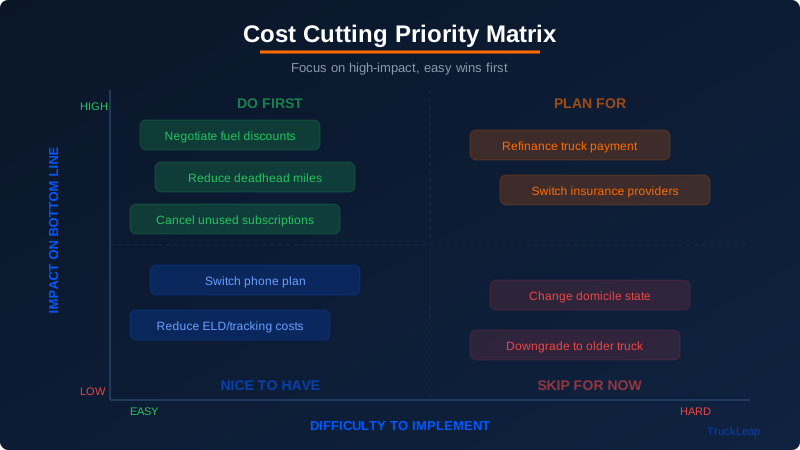
- 2Separate fixed from variable costs. Fixed costs (truck payment, insurance, rent, phone) exist whether your truck moves or not. Variable costs scale with activity. Attack variable first without touching fixed.
- 3Apply for factoring if you don't have it. If you're waiting 30–45 days for broker payments, factoring converts receivables to immediate cash. The 2–4% fee is real but beats a cash crisis.
- 4Contact your lender proactively. If you're approaching a payment you can't make, call your lender before you miss it. Most have hardship programs for commercial vehicles. Deferral or modification is far better than repossession.
Cut Variable Costs the Right Way
Deadhead miles: Every empty mile costs 60–80% as much as a loaded mile. In a slow market, you cannot afford to accept the status quo on deadhead. Run every load through the deadhead calculator and set a hard limit on empty repositioning.
Idle fuel consumption: Excessive idling can add $300–$600/month in unnecessary fuel costs. An APU or idle-off policy pays for itself quickly.
Food and accommodation: Truck stop restaurants and hotel stops are convenience premiums you can't afford in a downturn. A quality 12-volt refrigerator and meal prep discipline can save $200–$400/month.
Don't cut maintenance: A deferred oil change becomes a seized engine. A deferred tire rotation becomes a blowout that takes you off the road for days. Cut discretionary costs, not safety and maintenance.
Set a Hard Rate Floor and Hold It
The most self-destructive response to a slow market is accepting below-cost loads to "keep the truck moving." Hauling a load at $1.60/mile when your break-even is $1.75/mile doesn't help cash flow - it drains it. The truck moving is not the goal. Revenue above costs is the goal.
How to set your floor: Calculate total fixed costs per month, estimate realistic loaded miles per month, divide for fixed cost per mile, add variable cost per mile, then add a target profit margin (10–15% minimum). Every offer below this number gets declined.
Managing broker pressure: Brokers will push hard in a slow market. The response: "I understand the market is slow. My costs don't change with the market. I need at least $X/mile to cover costs. If that doesn't work for this load, I'll wait for the next one."
Use the Slow Period Strategically
A downturn is uncomfortable but it's also time - something you don't have during peak season. Catch up on deferred maintenance. Update your bookkeeping. Build knowledge about freight markets, lane rates, and business strategy. Build broker relationships you don't have time for in peak season.
If you've been self-dispatching through the downturn and struggling, a market recovery is the worst time to start working with a new dispatcher. Start the relationship now while there's time to calibrate.
The Cash Reserve Formula
| Reserve Target | Purpose |
|---|---|
| 1 month of fixed costs | Minimum operating buffer - never go below this |
| 3 months of fixed costs | Comfortable runway through a typical slow period |
| 6 months of fixed costs | Survives extended market downturns or major breakdowns |
Market Questions
Frequently Asked Questions
Down-Market Stories
How Carriers Survived the Slow Months
What worked when rates dropped and the boards went quiet.
“I've got two dry vans. During the slow season last month, they were the reason I didn't park the trucks. They managed to find backhauls that kept me out of the deadhead trap. Consistent, professional, and they don't hide the numbers.”
Robert M.
Denver, CO
Small fleet · 2 dry vans“The difference with TruckLeap is the communication. If a receiver is acting up or trying to dodge detention pay, my dispatcher is on them immediately. I don't have to argue anymore; I just send a text to TruckLeap and they handle the fight while I get my sleeper berth time.”
Janet L.
Nashville, TN
Reefer · O/O (MC# 148xxx)“I was tired of getting lowballed by brokers who knew I was empty in a dead zone. TruckLeap got me a backhaul out of Laredo that actually covered my fuel and then some. They don't just find loads; they strategize my whole week so I'm not sitting on my hands.”
Pavel G.
Philadelphia, PA
Solo · 2022 Kenworth dry vanWe Know Which Corridors Are Still Moving. Let Us Find Your Loads.
Apply in 5 minutes. Our broker relationships don't dry up when the spot market does.
Apply Now - Free Setup