
Load boards are where the majority of owner-operators find their freight. But with subscription costs piling up and a dozen options claiming to be the best, figuring out where to actually spend your time (and money) is genuinely difficult.
We evaluated 7 load boards that owner-operators actually use in 2026. Here is what we found.
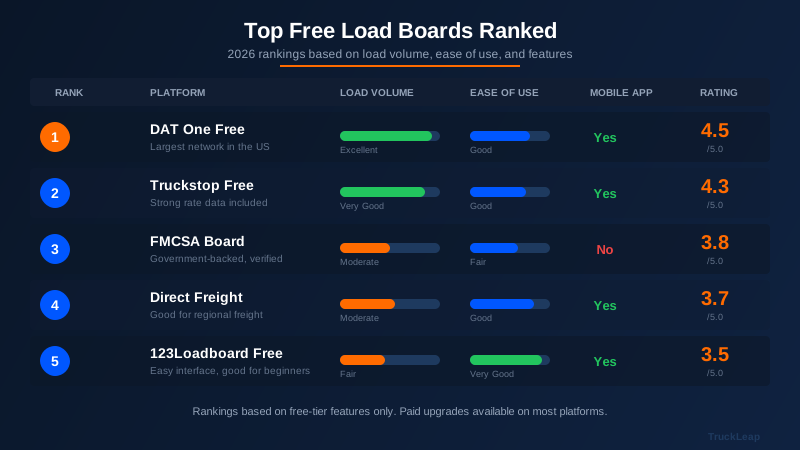
How We Evaluated Load Boards
Each board was assessed on:
- Load volume: How many loads are posted, and how often
- Rate quality: Whether posted rates are competitive with market
- New-authority friendliness: Whether brokers on the platform work with new MC numbers
- Equipment coverage: Which truck types are well-served
- Cost: Monthly subscription or per-use pricing
- Mobile experience: Usability from a phone or tablet in a truck cab
- Reliability: Payment history of brokers posting on the platform
Before committing to any load, use the Load Profitability Calculator to verify it makes financial sense. And calculate your deadhead cost with the Deadhead Calculator. A load that looks good on paper can lose money if the pickup is 150 miles away.
1. DAT One - Best Overall (Paid, But Worth It)
Cost: $150–$499/month depending on tier Load volume: Highest in the industry Best for: All equipment types, experienced operators, fleet owners
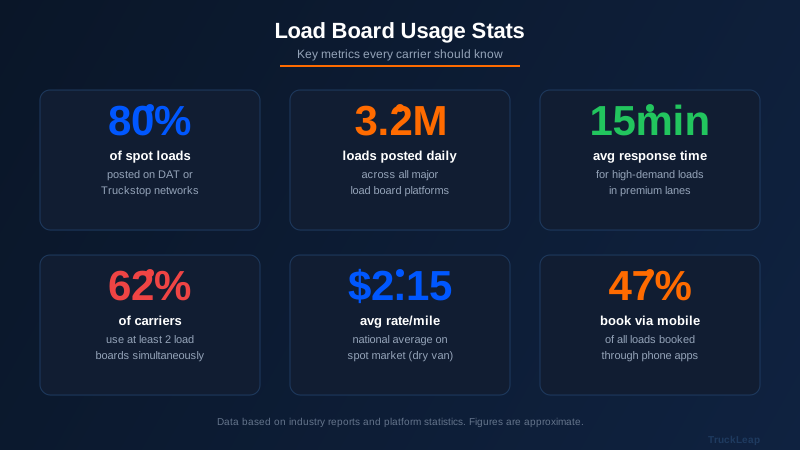
DAT is not free. But it belongs at the top of this list because it is the closest thing the trucking industry has to a standard, and because many carriers treat it as an essential business expense, not a luxury.
What makes DAT stand out:
- Over 800,000 loads posted daily across all equipment types
- Rate analytics tools showing lane-specific averages and market trends
- Carrier credit scoring for brokers (lets you assess payment reliability)
- Lane history tools to find your best recurring routes
- Integrated rate negotiation guidance
DAT's tiered pricing in 2026:
- DAT One Basic: ~$150/month - Load search, basic rate data
- DAT One Standard: ~$290/month - Adds lane history, advanced filters
- DAT One Premier: ~$499/month - Adds credit scores, market trends, API access
Pros:
- Largest load volume of any board
- Most broker contact information is verified
- Rate trend data helps you know when to hold versus take a load
- Excellent mobile app
Cons:
- Meaningful monthly cost, especially at higher tiers
- Not all brokers post on DAT (some use Truckstop exclusively)
- Load volume creates competition, and popular lanes fill fast
Verdict: If you are running full-time, DAT One at the Basic or Standard tier pays for itself with one or two better-negotiated loads per month.
2. Truckstop.com - Best DAT Alternative (Paid)
Cost: $39–$199/month Load volume: Second-largest in the industry Best for: Dry van, flatbed, reefer operators
Truckstop has historically been the closest competitor to DAT for overall load volume. In 2026, it has improved its rate analytics tools and carrier-side features significantly.
What Truckstop does well:
- Strong flatbed freight coverage (some argue better than DAT for flatbed)
- Rate check tool built into the search interface
- Broker payment history scores
- Fuel advance integration with select factoring partners
Truckstop vs. DAT:
| Feature | DAT One | Truckstop |
|---|---|---|
| Daily load volume | ~800K | ~600K |
| Rate analytics | Excellent | Good |
| Flatbed coverage | Good | Excellent |
| Reefer coverage | Excellent | Good |
| Mobile app | Strong | Adequate |
| Entry price | $150/mo | $39/mo |
Pros:
- Lower entry price than DAT
- Strong flatbed community
- Good payment history data on brokers
Cons:
- Lower overall load volume than DAT
- Some rate tools feel dated compared to DAT's analytics
- Mobile app less polished than DAT
Verdict: If budget is a constraint and you run flatbed, Truckstop at the $39/month entry tier is an excellent starting point. Serious operators often subscribe to both DAT and Truckstop.
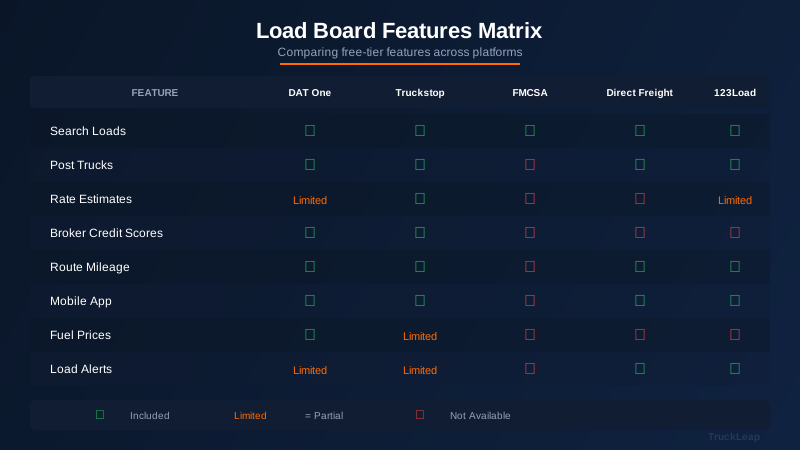
3. 123Loadboard - Best Freemium Option
Cost: Free (basic) / $35–$45/month (premium) Load volume: Moderate Best for: New authorities, budget-conscious operators, supplemental searching
123Loadboard is the best genuinely freemium option available. The free tier is usable, not just a teaser. It gives you real load results, broker contact info, and basic filters without requiring a credit card.
Free tier includes:
- Load search with basic filters
- Broker phone numbers
- Equipment type filtering
- Mobile app access
Paid tier adds:
- Rate check data
- Broker payment scoring
- Advanced lane filtering
- Mileage calculator integration
Pros:
- Free tier is actually useful, not artificially crippled
- Good mobile experience
- Lower load density means less competition on some lanes
- Works well as a supplemental board alongside DAT or Truckstop
Cons:
- Load volume is significantly lower than DAT or Truckstop
- Rate data on free tier is limited
- Some broker listings are outdated
Verdict: The right starting point for new authorities who cannot yet justify DAT's subscription cost. Graduate to DAT once you are running consistent loads.
4. CH Robinson Navisphere Carrier - Best Free Platform for Reliable Freight
Cost: Free Load volume: High (C.H. Robinson internal loads only) Best for: New authorities, operators wanting broker stability
CH Robinson is one of the largest freight brokers in North America. Their Navisphere Carrier platform gives carriers direct access to C.H. Robinson's available loads, no load board subscription needed.
What makes it valuable:
C.H. Robinson has a rigorous shipper vetting process and pays carriers reliably. While rates are not always top-of-market (they negotiate hard on the shipper side, and carrier margins reflect that), the freight is real, the payments are reliable, and new authorities can access loads immediately after completing carrier onboarding.
Pros:
- Completely free
- C.H. Robinson pays reliably (strong payment history)
- New authority friendly, with own vetting process, not dependent on Rmis scoring
- Nationwide freight density
- Good mobile app
Cons:
- Only shows C.H. Robinson's own loads (not a marketplace)
- Rates tend to be below spot market average
- Less flexibility in negotiation compared to spot market brokers
Verdict: Register here on day one of your new authority. It is free, reliable, and accessible. Use it alongside a marketplace board, not as your only source of freight.
5. Amazon Relay - Best for Consistent Rates (Free)
Cost: Free Load volume: High in Amazon freight corridors Best for: Dry van, box truck operators; new authorities; operators wanting rate stability
Amazon Relay is Amazon's carrier program for their surface transportation network. Carriers register through the Amazon Relay app, complete Amazon's own vetting, and access available loads from Amazon fulfillment and distribution centers.
What sets Amazon Relay apart:
- Fixed, non-negotiable rates posted upfront, no haggling
- Loads are consistent in nature (Amazon fulfillment freight)
- Payment is fast and reliable
- Amazon has its own insurance verification system (less dependent on Rmis)
- New authorities can access loads after completing onboarding
Pros:
- Free
- Predictable, reliable rates
- No negotiation needed (a genuine advantage for new operators)
- Fast payment (typically faster than traditional brokers)
- Heavy load volume in Amazon-dense markets (Atlanta, Dallas, Chicago, LA, Seattle)
Cons:
- Not available in all markets
- Rates are fixed, with no ability to negotiate upward on high-demand days
- Amazon lanes can be repetitive (same corridors repeatedly)
- Operational requirements are strict (on-time performance metrics matter)
Verdict: An excellent free load source, especially in your first 90 days. Combine with Navisphere Carrier to have two reliable free freight sources while building your broker network.
6. uShip - Best for Niche and Specialty Freight
Cost: Free to list; uShip takes 15–17% platform fee Load volume: Low (specialty freight only) Best for: Hotshot, partial truckload, specialty equipment operators
uShip operates differently from traditional load boards. Shippers post freight directly (bypassing brokers), and carriers bid on loads. The platform skews heavily toward specialty freight: vehicles, boats, heavy equipment, unusual dimensions.
uShip is worth knowing about if:
- You run hotshot (under CDL, partial loads)
- You have a specialty trailer (lowboy, flatbed, enclosed auto)
- You want direct shipper relationships without brokers
Pros:
- Direct shipper contact, no broker in the middle
- Good for specialty freight that does not appear on traditional boards
- Free to register and bid
Cons:
- uShip's 15–17% platform fee reduces your effective rate significantly
- Load volume is very low compared to DAT or Truckstop
- Most loads are one-time, relationship-building is harder
- Customer service quality of shippers varies widely
Verdict: A secondary tool for specialty operators. Not a primary freight source for most owner-operators. When evaluating uShip loads, always run the numbers through the Profit Calculator. The platform fee plus deadhead to pickup can quickly erode what looks like a solid rate.
7. Facebook Freight Groups - Best for Local Networking (Free)
Cost: Free Load volume: Varies by group and region Best for: Regional operators, relationship building, market intelligence
Facebook has dozens of active trucking freight groups where brokers post loads directly and carriers seek freight in specific lanes. The largest groups have thousands of members and active daily posting.
Useful groups to find: search "freight loads [your state]" or "truck loads [city]" on Facebook Groups.
What Facebook freight groups are good for:
- Regional lanes that do not appear on national load boards
- Direct shipper relationships that develop through repeated group interaction
- Market intelligence: what are brokers offering for your lanes right now?
- Connecting with local shippers who post outside of broker networks
What they are not good for:
- Consistent, reliable freight at scale
- Vetting brokers (no payment history data)
- Professional load management
Pros:
- Free
- Regional freight that does not appear on major boards
- Some direct shipper relationships available
- Good market intelligence for lane rates
Cons:
- No payment verification for brokers
- Scam risk is higher than regulated boards
- Inconsistent load quality
- Not scalable as a primary load source
Verdict: Use Facebook groups for market intelligence and regional lane research. Never skip broker vetting just because a load comes from a Facebook group.
Load Board Comparison Table
| Load Board | Cost/Month | Daily Loads | New Authority | Best Equipment | Mobile App |
|---|---|---|---|---|---|
| DAT One | $150–$499 | ~800K | Broker-dependent | All types | Excellent |
| Truckstop.com | $39–$199 | ~600K | Broker-dependent | Flatbed, dry van | Adequate |
| 123Loadboard | Free / $35–$45 | Moderate | Yes | All types | Good |
| CH Robinson Navisphere | Free | High (CHR only) | Yes | Dry van, flatbed | Good |
| Amazon Relay | Free | High (Amazon only) | Yes | Dry van, box truck | Excellent |
| uShip | Free (+ 15% fee) | Low | Yes | Specialty | Adequate |
| Facebook Groups | Free | Variable | Yes | Regional all types | N/A |
What Strategy Works Best
If you are new (under 90 days of authority): Start with Amazon Relay + CH Robinson Navisphere Carrier (both free, both new-authority accessible) plus 123Loadboard's free tier. Once you have 5–10 completed loads and your insurance certificate is propagated, add DAT One at the Basic level.
If you are established (90+ days): DAT One is the core tool. Add Truckstop if you run flatbed. Keep Amazon Relay for steady fill freight between better spot market loads.
If you want to maximize earnings without managing load boards yourself: A dispatch service handles all of the above and negotiates rates you cannot typically reach as a single-truck operator. Read our dispatch vs load board comparison to see the full cost and rate breakdown, then review dispatch pricing to run the math on your specific operation. New authorities in particular benefit from the established broker relationships a dispatch service brings; learn more at /dispatch/new-authority. If you're ready to reduce your reliance on load boards entirely, our guide on how to leave the load board behind covers the full transition strategy.
Whatever approach you take, evaluate every load you find with the Load Profitability Calculator before committing, and calculate the deadhead cost with the Deadhead Calculator before you agree to a distant pickup.
Frequently Asked Questions
Is DAT worth the cost for a single-truck owner-operator?
Yes, for most operators. The Standard tier at ~$290/month gives you rate analytics that consistently help negotiate $0.10–$0.20/mile better rates. At 10,000 miles/month, a $0.15/mile improvement is $1,500/month in additional revenue, more than 5x the subscription cost. The break-even point is actually very low.
Can I use multiple load boards at the same time?
Absolutely, and most successful operators do. The most common combination is DAT + Truckstop, or DAT + 123Loadboard for budget-conscious operators. Free platforms (Amazon Relay, Navisphere Carrier) layer on top of any paid subscription at no additional cost.
How do I know if a broker I found on a load board will pay me?
Use DAT's credit score tool (included in most paid tiers) or Truckstop's payment history ratings to check any broker before accepting their load. Also verify the broker's FMCSA operating authority at safer.fmcsa.dot.gov. Make sure they are licensed and bonded. Brokers with no credit history on these platforms should be treated with caution, especially for high-value loads.
Do load board subscriptions include rate negotiation help?
DAT One at higher tiers includes lane rate history data and market trend reports, which inform your negotiation. But the actual negotiating is still up to you (or your dispatcher). A load board shows you what freight is available and what it is paying. It does not negotiate for you.
Is the Amazon Relay rate always lower than the spot market?
Not always. Amazon Relay rates are fixed and transparent. In tight capacity markets when spot rates spike, Amazon's fixed rates can be below the going spot rate. In soft markets when spot rates fall, Amazon's consistent rates can actually be above what you could negotiate on a load board. The predictability is the value, not necessarily always maximum rate.
Data references: DAT Solutions 2025 annual market report, Truckstop.com carrier survey data, owner-operator usage surveys from TruckersReport community, Amazon Relay carrier documentation.